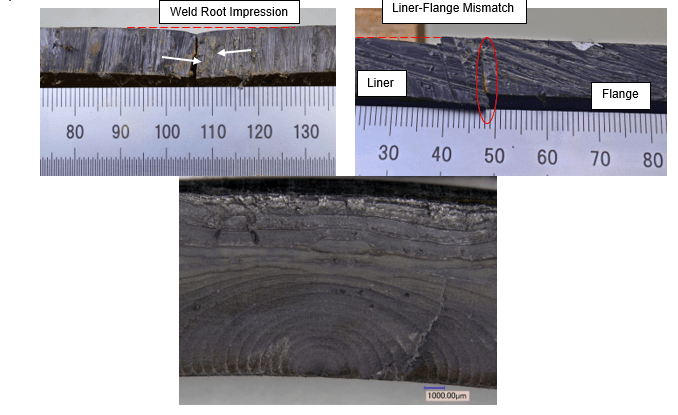
Non-metallic materials, such as plastic liners in pipelines, protect carbon steel pipe from inside surface corrosion. However, installation practices have a crucial role in the successful use of non-metallics. The images below are of failures in high-density polyethylene (HDPE) liners pulled through disposal water pipelines that failed after several years of service.
The top left image shows a cracked cross section of a liner (between the white arrows). The crack was aligned with the inward impression shown; the impression was present around the entire liner circumference. The customer indicated that the failure occurred at a proud girth weld root in the carbon steel. Prior to lining an existing pipeline, locations with excessive internal penetration (such as at girth welds) must be removed.
The top right shows the fusion joint between a liner and a liner flange. The joint is mismatched such that the liner bends inward under the flange by more than 15%. The crack occurred at the fusion between the two materials. Typically, for these materials, joint misalignment should be less than 10%.
The bottom image shows a fracture surface typical of HDPE through wall cracks; both failures had similar appearances. The failure has a distinct origin with concentric rings progressing outwards from the origin. The liner failures were associated with local deformation; the mechanism is Slow Crack Growth (SCG).
The failures were associated with weld root impressions from the steel casing and at the misalignment at a liner to flange fusion bond. These are locations of higher stresses.
Polymers have a time dependent strain response. Constant applied stresses develop increasing strain in these materials; these effects are magnified at stress concentrations.
Stress concentrators in non-metallics should be minimized – minimizing misalignment and preventing notches is key to preventing failures. However, specific quality requirements are typically not addressed by standards and must be agreed with equipment suppliers before starting the project.